ADHD romantic relationships present unique challenges that many couples struggle to understand. If you or your partner has ADHD, the emotional intensity, forgetfulness, and miscommunication that often come with the condition are not signs of not caring — they are signs of a brain that is wired differently. Understanding why ADHD affects relationships, and what actually helps, is the first step to building something stronger.
NICE estimates that around 3–4% of adults in the UK live with ADHD. For many, the impact on their closest relationships is one of the most painful parts of living with the condition.
Why ADHD Makes Romantic Relationships So Hard
ADHD affects the brain’s executive functions — the systems governing attention, impulse control, emotional regulation, and working memory. In a relationship, these are not abstract deficits. They show up as missed anniversaries, half-finished conversations, emotional outbursts that seem disproportionate, and a sense that your partner is not listening even when they are trying their hardest.
Research published in the European Society of Medicine found that adults with ADHD report significantly lower relationship satisfaction compared to those without. One landmark study found that up to 96% of spouses of adults with ADHD felt their partner’s symptoms interfered with functioning at home — in areas like household organisation, communication, and child-rearing.
Perhaps the most striking finding: adults diagnosed with ADHD in childhood are up to three times more likely to divorce than adults without ADHD.
These statistics are not meant to dishearten. They exist because ADHD was simply not recognised or addressed in most of these relationships. Understanding the ‘why’ changes the picture considerably.
Emotional Dysregulation: The Hidden Driver
One of the least understood aspects of ADHD in relationships is emotional dysregulation — the difficulty regulating emotional intensity and recovering from upsetting moments.
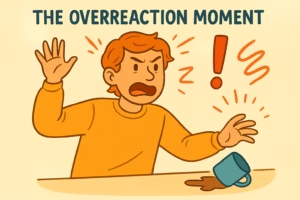
A 2023 systematic review published in Frontiers in Psychiatry found that up to 90% of adults with ADHD experience some form of emotional dysregulation. Small frustrations escalate quickly. Moments of perceived criticism can trigger an intense reaction that surprises both partners. This is not anger — it is a nervous system that processes emotional input at high intensity, often without the usual buffering of neurotypical emotional regulation.
For people with rejection sensitive dysphoria (RSD), the experience can be even more acute. A partner’s neutral tone can register as disapproval. A short reply can feel like rejection. And the emotional fallout — however disproportionate it seems from the outside — is completely real from within.
What Both Partners Experience
A 2025 qualitative study published in the Journal of Marital and Family Therapy, involving 355 adults with ADHD, identified two dominant relationship themes: “the emotional rollercoaster of rejection sensitivity” and “ADHD’s battle between passion and distraction.” Participants described a pattern of intense engagement followed by periods of apparent disinterest — not because they stopped caring, but because their attention had moved elsewhere.
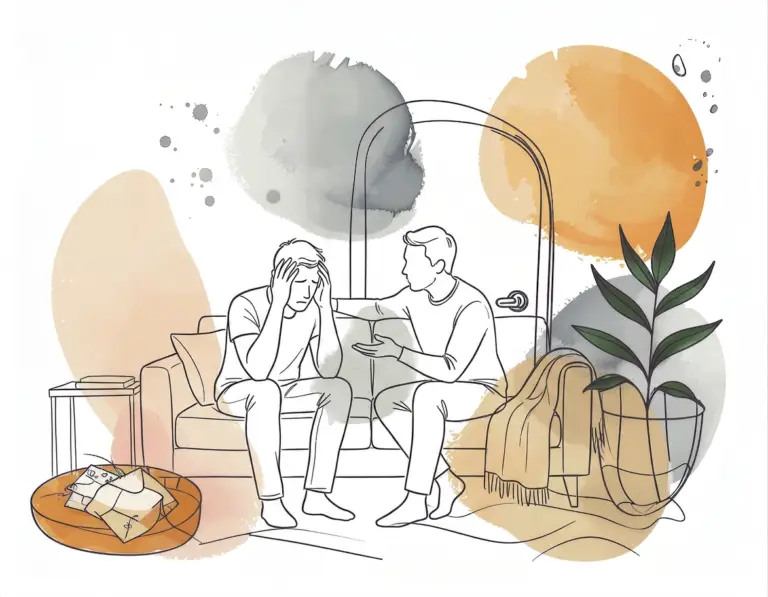
The non-ADHD partner often absorbs the organisational load of the relationship: remembering appointments, managing social commitments, following up on important tasks. Over time, this can create an imbalanced dynamic where one partner feels more like a carer or coordinator than a companion.
“ADHD symptoms are not a reflection of your love or your intent — they are a reflection of how your brain is wired.”
— Melissa Orlov, author of The ADHD Effect on Marriage
This framing matters. When both partners understand the neurological basis of the friction — rather than interpreting it as carelessness or lack of love — the conversation changes. Blame makes room for problem-solving.
Using the Dream SMART Framework to Set Relationship Goals
One of the challenges with ADHD and relationships is that good intentions frequently run into the same obstacles: difficulty sustaining effort over time, getting derailed by emotional overwhelm, and losing sight of longer-term goals when the immediate moment demands attention.
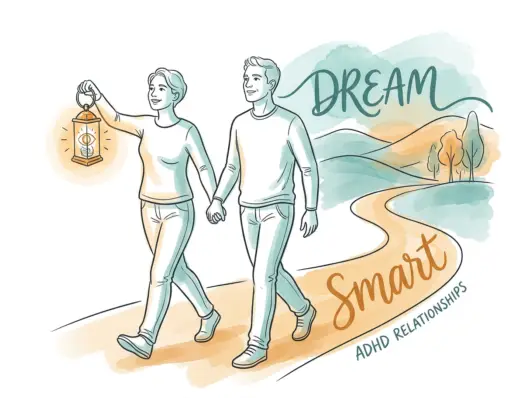
The Dream SMART Framework, developed by ADHD coach Waldo Hechter, offers a structured approach that works with the ADHD brain rather than against it. Applied to relationships, it begins not with a list of rules but with a vision — what does a connected, loving partnership actually look and feel like for you?
That vision becomes the emotional anchor. From there, you set small, specific, achievable actions — not “communicate better,” but “spend ten minutes after dinner checking in, phones away.” Then comes awareness: identifying which internal patterns (the Restless pull toward distraction, or the Hyper-Vigilant anxiety about being criticised) get in the way. Finally, you use your character strengths — curiosity, empathy, love — as the active counter to those patterns.
| Dimension | Traditional SMART | Dream SMART |
|---|---|---|
| Starting point | Specific goal | Vision / Dream |
| Motivation driver | External deadline or reward | Values-based emotional ‘why’ |
| Action design | Measurable milestones | Small, neurologically sustainable steps |
| Awareness | Progress tracking only | Saboteur and character strengths identification |
| Review process | Achievement review | Reflective learning loop |
| Time frame | Fixed deadline | Momentum-based rhythm (72-hour cycle) |
Applied to relationships, this means beginning with a question: what kind of partnership do I genuinely want? That clarity gives you a compass for the difficult weeks — not just a checklist.
Practical Strategies That Help
Use structure to reduce friction. A weekly ten-minute check-in — same time, same format — removes the cognitive burden of deciding when to have important conversations. Predictability helps the ADHD brain engage more fully.
Separate the behaviour from the person. When impulsive comments or missed commitments cause hurt, practise naming the behaviour without attacking the character. “It hurts when plans get forgotten” lands differently to “You never listen.”
Build in repair rituals. Every couple has conflict. What matters is how quickly and reliably you reconnect afterwards. A consistent repair ritual — even as simple as a hug and “I’m sorry, I love you” — shortens the emotional recovery time significantly.
Manage ADHD mood swings proactively. Identify the situations that reliably trigger emotional dysregulation — tiredness, hunger, overstimulation — and work together to reduce exposure during vulnerable moments.
Consider couples coaching or therapy. A therapist or coach experienced with ADHD can help both partners understand the dynamic from the outside, and give both of you tools that neither could easily develop alone.
Frequently Asked Questions
Yes. Research consistently shows that understanding, communication, and appropriate support dramatically improve relationship outcomes for adults with ADHD. Many couples find that an ADHD diagnosis — even a late one — actually strengthens their relationship by replacing blame with understanding.
Not inevitably. ADHD brings real strengths into relationships too — intensity, creativity, spontaneity, and deep empathy. The difficulties arise primarily when ADHD goes unrecognised or unsupported. With awareness, both partners can build systems and habits that work for their shared life.
This is a personal decision. Many adults with ADHD find that early disclosure builds understanding and avoids the frustration that builds when symptoms are misread as carelessness or lack of interest. There is no obligation to disclose, but open conversation tends to support more authentic and resilient relationships.
An ADHD coach works with you to understand your patterns, build practical strategies, and develop the self-awareness needed to manage your responses more intentionally. Coaching does not replace couples therapy, but it can help you show up more consistently in your relationship.
Rejection sensitive dysphoria (RSD) is an intense emotional response to real or perceived rejection or criticism. In relationships, it can make constructive feedback feel devastating, cause disproportionate reactions to minor conflicts, and create anxiety about a partner’s intentions. RSD is closely linked to ADHD and responds well to coaching and, in some cases, medication.