GET YOUR WORKBOOK HERE
The Dream SMART
Framework Workbook
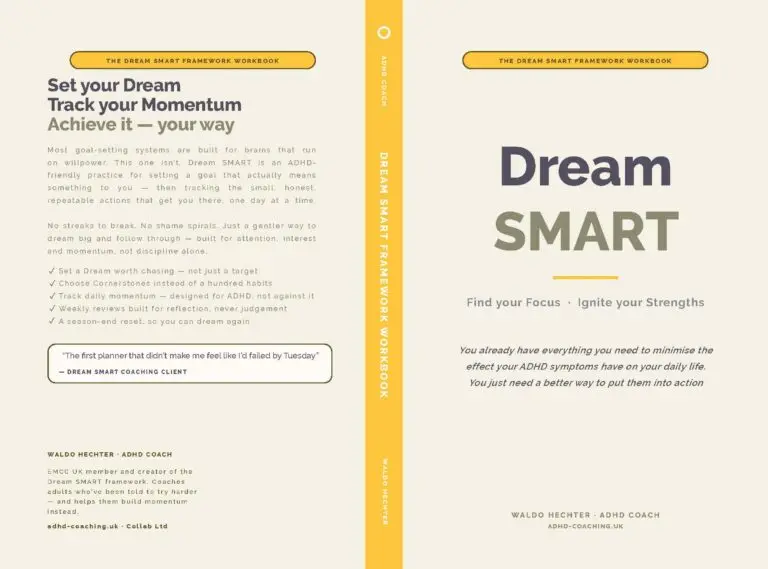
The Dream SMART Workbook has just launched, giving ADHD coaching clients and anyone new to the framework a hands-on, companion for turning big, exciting dreams into small daily actions. If you have ever set a New Year’s resolution in January and lost all momentum by February, this workbook was built with exactly that pattern in mind. It takes the Dream SMART Framework already used in one-to-one ADHD coaching and puts it into your own hands, one week at a time.
This is not another productivity planner designed for a neurotypical brain. It is built around how ADHD brains actually find, lose, and rebuild motivation, and it rewards momentum rather than perfection.
What Is the Dream SMART Workbook?
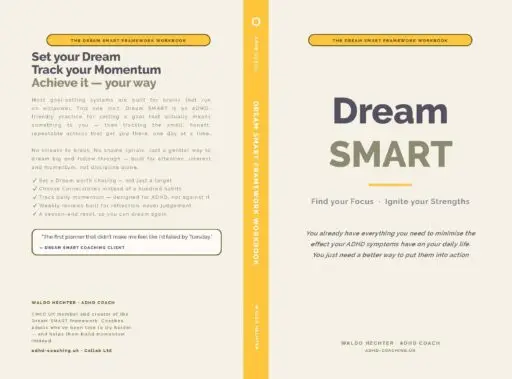
The Dream SMART Workbook is a printed guide that walks you through setting a genuinely motivating “Dream”, then breaking it down into SMART actions your brain can realistically follow through on. Each week follows the same rhythm: read a short section, reflect on a couple of prompts, complete that week’s coaching-style exercise, and jot down notes as the week unfolds. By the final spread, you look back at how far you have come and look ahead to what is next.
Crucially, the workbook includes a clear line early on: it is not a substitute for medical or psychological treatment. It sits alongside NHS care, therapy, or medication as a practical, structured tool, not a replacement for any of them.
Why Traditional Goal-Setting Doesn’t Work So Well for ADHD Brains
Most of us have tried standard SMART goals at some point. Specific, Measurable, Achievable, Relevant, Time-bound. On paper, it is sound advice. In practice, it quietly assumes steady motivation, reliable memory, and a brain that treats a deadline six months away as real and urgent. For many ADHD brains, that assumption falls apart fast, and a task that lacks novelty or urgency can lose its pull almost entirely, no matter how important it is.
The Dream SMART Framework keeps the SMART structure but rebuilds it around how ADHD motivation actually works.
| Traditional SMART | Dream SMART |
| Specific: the task alone | Specific: the task, anchored to a personal Dream that makes it feel worth doing |
| Measurable: tracked by numbers or deadlines | Measurable: tracked by small wins and visible momentum, not just outcomes |
| Achievable: assumes consistent motivation | Achievable: built around energy levels, dopamine and realistic steps, not willpower |
| Relevant: fits into a broader plan | Relevant: connects to your values and what genuinely excites your brain |
| Time-bound: a fixed deadline | Time-bound: flexible check-ins, so a bad week doesn’t mean starting from scratch |
That last point matters more than it might sound. Many adults who reach for a workbook like this have already tried “just use a planner” and watched it fail, often more than once. Dream SMART is designed to survive a wobble, not collapse the moment life gets in the way.
Inside the Workbook: How the Five-Part Structure Works
The Dream SMART Workbook takes readers through five stages, each building on the last.
Set your Dream comes first, helping you get honest about what you actually want, rather than what you feel you should want. Choose your Cornerstones follows, identifying the two or three values or habits that will anchor your weeks when motivation dips. Design your week turns those cornerstones into a realistic weekly shape, built around your actual energy and schedule rather than an idealised one. Choose your rhythm helps you settle on a repeatable pattern for check-ins and reviews, so structure becomes a habit rather than a chore. Finally, Show up daily brings it back to small, achievable actions you can complete even on a difficult day.
Each week closes with a short coaching-style session and a notes page, giving the workbook a similar feel to sitting across from an ADHD coach, minus the appointment.

Why Momentum Matters More Than Perfection
If there is one phrase that sums up the whole workbook, it is this: momentum matters more than perfection. Missing a day, or even a whole week, does not mean starting again from zero. The weekly rhythm is built for restarts, because for ADHD brains, all-or-nothing thinking is often what kills a goal in the first place, not lack of ability.
This lines up with what the research on goal-focused support for ADHD adults actually shows. Studies of goal management training and coaching-style interventions have found improvements in executive functioning and everyday follow-through when goals are broken into small, structured steps with regular check-ins, rather than left as one large, distant target. A workbook that builds in weekly reflection and flexible restarts is putting that same evidence-based principle into a format you can use on your own kitchen table.
Getting Extra Support: Coaching Alongside the Workbook
The Dream SMART Workbook works well as a stand-alone tool, but it was written to complement, not replace, ADHD coaching. Coaching adds accountability, body doubling, and a second perspective on the saboteurs that tend to appear around week four or five, exactly when early enthusiasm fades and old patterns try to creep back in.
If you want a sense of what that support looks like in practice, our case study on breaking the loop of ADHD challenges through coaching shows how one client moved from feeling stuck to building consistent routines with a coach beside them. The Dream SMART Framework page has more detail on how one-to-one coaching sessions work if you decide you would like extra support alongside the workbook.
Practical Tips to Get the Most from the Workbook
A few small habits make a real difference to how well the workbook lands.
Keep it visible. A workbook buried in a drawer will not get used, however good the content is. Leave it somewhere you already look every day, such as beside the kettle or on your desk.
Do not skip the reflection prompts, even when they feel awkward. They are doing more of the work than the action steps themselves, because they are what connects a task back to your Dream.
Protect your weekly rhythm slot. Whether that is Sunday evening or Wednesday lunch break, the same time and place each week helps the habit stick, echoing advice on routine tasks that shows environment matters as much as willpower.
Treat a missed week as data, not failure. If your cornerstones keep slipping, that is chronic disorganisation talking, not proof the framework is not working for you, and it is worth revisiting your cornerstones rather than abandoning them.
Pair it with support if you can. Whether that is a coach, a friend, or an accountability partner, having someone to check in with mirrors the structured, small-step approach shown to help ADHD adults build lasting follow-through, and it works alongside strategies for fighting distraction and staying on task.
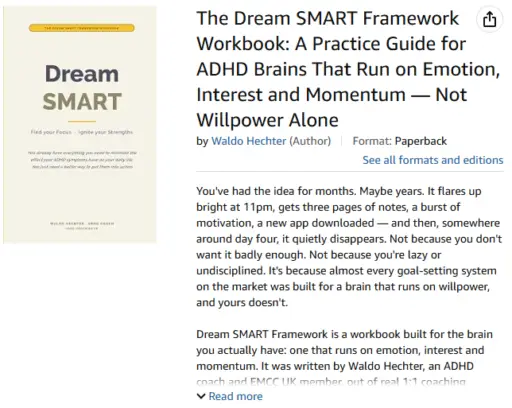
Order your copy from Amazon in paperback or hard copy to get started this week.
Frequently Asked Questions
Is the Dream SMART Workbook only for people who already have an ADHD coach?
No. It is designed to work as a stand-alone tool for anyone who wants a structured, ADHD-friendly approach to goals, though it also works well alongside coaching for extra accountability.
How long does the Dream SMART Workbook take to complete?
It is built around a twelve-week structure, with one short weekly session, though you can move through it at whatever pace suits you and repeat weeks if needed.
Does the workbook replace medication or therapy for ADHD?
No. The workbook is explicit that it is not a substitute for medical or psychological treatment. It is a practical companion to sit alongside NHS care, therapy, or medication, not a replacement for any of them.
What if I fall behind on the weekly rhythm?
That is expected and built into the design. The framework is intended to survive missed weeks, so you pick back up rather than starting over from scratch.
A Dream Worth Chasing, One Small Step at a Time
The Dream SMART Workbook takes a coaching approach that already has a track record with ADHD clients and makes it available to anyone ready to turn a Dream into a plan they can actually stick to. It will not make motivation effortless, nothing does, but it gives your ADHD brain a structure built for how it really works, not how goal-setting guides assume it should.