

An ADHD waiting list is the queue of people who have been referred for a specialist ADHD assessment but have not yet been seen, and in England many adults now wait years rather than months. Knowing why the wait is so long, and what you can do during it, means the time on the ADHD waiting list does not have to be lost time.
If you have been told “it could be a while”, you are far from alone. Here is what the numbers say and what you can do now.
Why Is the ADHD Waiting List So Long?
Demand has grown much faster than the services built to meet it. NHS England data shows there were up to 959,662 open referrals in England that may be for an ADHD assessment in June 2026, and new referrals were 46.7% higher than a year earlier. The same publication estimates that around 2.48 million people in England have ADHD.
The independent ADHD Taskforce, set up by NHS England, found that adults can wait more than eight years in some areas, with some local waiting lists stretching to 10 to 15 years. In a national survey it reviewed, 40% of people reported waiting two years or more.
These figures describe NHS services in England. Scotland, Wales and Northern Ireland run their own services and their own waits. If you live outside the UK, the practical steps later in this guide still apply wherever you are waiting.

Check Where You Stand
Contact the service you were referred to, or your GP practice, and ask three things: are you definitely on the list, roughly how long is the current wait, and who do you contact if things change? Write the answers down with the date, so you are not relying on memory once you are on the ADHD waiting list for months.
In England, you may also be able to use your legal right to choose where you are referred for a first mental health appointment, including some providers that offer NHS-funded ADHD assessments. The NHS page on ADHD in adults says you may be able to find a clinic with a shorter wait this way. Local arrangements vary and have changed in some areas, so ask your GP what applies to you.
You Don’t Need a Diagnosis to Start Getting Support
A diagnosis matters, and it opens the door to medication. But a lot of useful help does not depend on it.
The ADHD Taskforce was clear on this point:
“In sectors that do not engage in clinical decision making, support should focus on needs and not rely on or wait for a diagnosis.”
Report of the independent ADHD Taskforce: Part 2, NHS England, 2025
In practice, that means you can ask your employer, college or university for changes based on what you find hard, such as written instructions, quieter workspace or flexible start times. You can join peer support groups.
Coaching is another option. An ADHD coach does not diagnose, but helps with planning, starting tasks and following through. If you are unsure which kind of help fits, our guide to ADHD coaching vs therapy sets out the differences.
Practical Strategies While You’re on the ADHD Waiting List
Keep a simple symptom and impact diary
Assessments ask how your traits affect daily life, now and in childhood. A short weekly note of what went wrong and what helped gives you real examples to bring. Old school reports are worth gathering too. Our article on how ADHD is diagnosed in adults explains what the process usually involves.
Build one routine at a time
Pick one sticking point, such as getting out of the door on time, and build a small routine around it. Our guide to building routines that stick with ADHD has ideas you can start this week.
Watch your energy
Many people reach the ADHD waiting list after years of pushing through. If you are exhausted, irritable and dropping things you used to manage, read up on recognising ADHD burnout and tell your GP. Being on an ADHD waiting list doesn’t mean other health concerns have to wait.
Using the Dream SMART Framework While You Wait

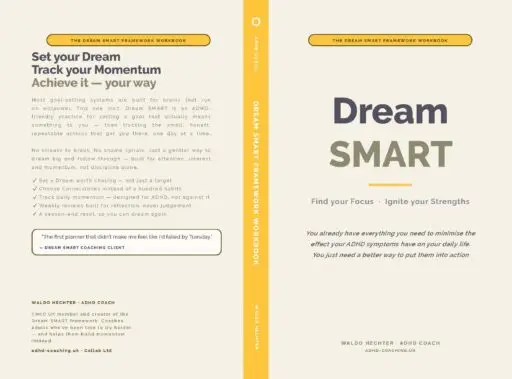
Dream SMART is a goal-setting approach designed for ADHD brains, and it works whether or not you have a diagnosis yet. It has two complementary halves. DREAM is your why: Dream Visualisation (“I see myself…”), Relevant to your personal values, Emotionally Connected, Actionable Steps and Momentum-Based. SMART is your how: Specific, Measurable, Achievable, Realistic and Time-bound.
Traditional SMART goals skip the why. Dream SMART anchors a goal to your values and emotions first, then applies structured action. The most important difference for ADHD is the E, Emotionally Connected. The ADHD brain runs on emotion, interest and urgency, not logic, so if a goal doesn’t excite you, scare you or deeply matter, the advice is to redesign it.
On a long ADHD waiting list, “get organised before my assessment” is vague and easy to drop. A Dream SMART version might start with “I see myself walking into my assessment calm and prepared” and become one action: “Every Sunday for 15 minutes, I add three examples to my diary.” Success is measured by “Did I try?”, not by perfection.
It is for any adult with ADHD traits, diagnosed or waiting, who has watched sensible goals fade. You can read more about why goal-setting keeps failing with ADHD.
Looking After Your Wellbeing on a Long Wait

Many people feel relief at finally having a name for their experience, then frustration that confirmation is years away. Both reactions are common. Your difficulties are real whether or not a letter confirms them yet, so talk to people who get it: a peer group, a friend or a coach.
Ask the service for regular updates while you are on the ADHD waiting list. The Taskforce noted that people with lived experience want clearer communication about waits and signposting to local support, so asking is reasonable.
And if your mental health gets worse while you wait, don’t hold on for the assessment. Contact your GP, or NHS 111 if it is urgent. If you live elsewhere, use your local urgent health services.
Frequently Asked Questions
It depends heavily on where you live. The NHS England ADHD Taskforce found adults can wait more than eight years in some areas, and some local lists are 10 to 15 years long. Others are shorter. Ask your GP or the service you were referred to for their current estimate, and check whether Right to Choose could offer a shorter wait.
Yes. Workplaces, colleges and universities can make changes based on your needs, and the ADHD Taskforce says support outside clinical settings should not wait for a diagnosis. Peer support groups, self-help reading and ADHD coaching are also open to you. Medication does need a specialist assessment, so a diagnosis is still worth pursuing.
Right to Choose is a legal right in England that lets you choose where you are referred for a first mental health appointment, including some providers that offer NHS-funded ADHD assessments. You ask your GP to make the referral. It can shorten the wait, but local arrangements vary, so ask your practice what applies in your area.
It can be faster, but check a few things first. Make sure the provider follows NICE guidance and uses qualified specialists. Ask your GP in advance whether they would accept a shared care agreement for any medication, because some practices do not, which can leave you paying private prescription costs long term.
Yes. A coach does not diagnose or prescribe, but can help with the daily challenges that led you to seek an assessment: planning, starting tasks, managing time and keeping track of commitments. Many people find coaching useful before diagnosis, and it can also help you prepare clear examples for your assessment appointment.