If you have ADHD and depression, you are not alone. ADHD and depression are two of the most commonly co-occurring conditions in adults, with research showing that approximately 38% of adults with ADHD also experience a depressive disorder. That is not a coincidence. The two conditions share overlapping neurobiology, and the daily experience of living with ADHD — the missed deadlines, the forgotten commitments, the sense of never quite keeping up — creates fertile ground for low mood. Understanding why ADHD and depression occur together is the first step toward getting the right support.
What Is the Link Between ADHD and Depression?
ADHD (Attention Deficit Hyperactivity Disorder) affects the brain’s ability to regulate dopamine and noradrenaline — two neurotransmitters central to mood, motivation, and focus. Depression involves many of the same systems. This neurobiological overlap means the two conditions are closely connected at a biological level.
But the link is not just chemical. It is also lived experience.
Adults with undiagnosed or untreated ADHD often spend years blaming themselves for difficulties that are actually neurological. They are told they are lazy, careless, or not trying hard enough. Over time, this constant criticism — from others and from within — erodes self-esteem. That erosion is one of the most direct pathways from ADHD to depression.
The 2023/24 NHS Adult Psychiatric Morbidity Survey found a significant bidirectional association between ADHD and major depressive disorder in English adults. In other words, each condition increases the risk of the other — and treating just one without addressing the other rarely works.

Why ADHD and Depression So Often Co-Occur
There are several distinct reasons why ADHD and depression appear together so frequently.
Chronic stress and failure. Executive function difficulties — trouble planning, starting tasks, managing time — mean that adults with ADHD face repeated setbacks. Each unmet deadline adds weight. That accumulation of perceived failures is a significant contributor to low mood.
Rejection Sensitive Dysphoria (RSD). Many adults with ADHD experience rejection sensitive dysphoria — an intense emotional response to perceived criticism or rejection. When RSD hits repeatedly, it can deepen into a persistent depressive state.
ADHD burnout. The effort of masking ADHD symptoms, performing neurotypical behaviour, and managing daily life without adequate support can lead to ADHD burnout. Burnout and depression share many features — exhaustion, withdrawal, low motivation — and they often arrive together.
Shared neurobiology. A 2025 systematic review in Frontiers in Psychiatry confirmed that ADHD and depressive disorders share genetic risk factors and overlapping dopamine dysregulation. For some people, both conditions arise from the same underlying biology — not just the stress of living with ADHD.
Sleep disruption. ADHD commonly disrupts sleep — the brain struggles to wind down at night. Poor sleep is both a symptom of depression and a cause of it, creating a cycle that is hard to interrupt without addressing both conditions.
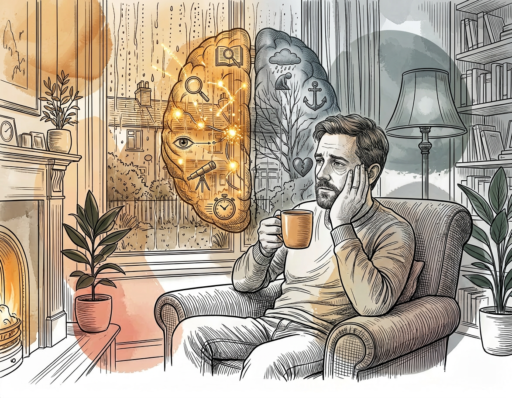
How to Tell If You Have ADHD, Depression, or Both
This can be genuinely confusing. Both conditions cause low motivation, difficulty concentrating, and a sense of underachievement. But there are differences worth knowing.
Depression tends to be a change from your baseline — a sustained drop in mood, energy, and interest that did not used to be there. ADHD, by contrast, tends to be lifelong. The struggles with focus, impulsivity, and organisation have usually been present since childhood, even if they were not recognised as ADHD at the time.
If you notice that your motivation improves significantly when you are doing something genuinely interesting or stimulating — a hallmark of ADHD hyperfocus — that suggests ADHD may be part of the picture. With depression alone, motivation tends to be flat across all activities.
That said, many people have both. If you are unsure, speaking to your GP is the right starting point. You can request a referral for an ADHD assessment through the NHS or use the Right to Choose pathway to access an assessment more quickly in England.
The Dream SMART Framework: A Coaching Approach to ADHD and Depression
When you are managing both ADHD and depression, conventional goal-setting often makes things worse. Traditional SMART goals assume consistent energy and motivation — an assumption that simply does not hold. The Dream SMART Framework, developed specifically for adults with ADHD, takes a different approach. It starts with vision and emotional connection before asking you to commit to any specific action. The ADHD brain runs on emotion and interest, not willpower.
The framework has two layers. The DREAM layer asks you to connect with your vision (Dream), link it to your personal values (Relevant), ensure it feels emotionally meaningful (Emotionally Connected), break it into actionable steps (Actionable), and build momentum gradually (Momentum-Based). The SMART layer gives those steps structure — Specific, Measurable, Achievable, Realistic, and Time-bound — but redesigned for variable energy and attention.
When depression is part of the picture, the Achievable and Realistic elements become especially important. The framework’s Low-Barrier Entry Principle — “What is the smallest possible version of this action I could do today?” — helps you build momentum even on your lowest days. The article on ADHD goal-setting shows this in practice.
| Element | Traditional SMART | Dream SMART |
|---|---|---|
| Starting point | Define the goal | Define your vision / dream |
| Motivation source | External deadline or outcome | Emotional connection & personal values |
| Energy assumption | Consistent | Variable — designed for fluctuation |
| Success measure | Binary: hit or miss | Direction of travel; progress counts |
| Response to failure | Start again from scratch | Reflect, adjust, and continue |
| Core driver | Willpower & discipline | Emotion, interest & momentum |
“Adults with ADHD experience significantly higher rates of depression and anxiety than the general population, yet these conditions often go unrecognised and undertreated in clinical settings.”
— NHS ADHD Taskforce Interim Report, NHS England, April 2025
Practical Strategies to Support Your Mental Wellbeing
Seek a proper diagnosis first. Treating depression alone, without addressing underlying ADHD, often produces limited results. A 2025 review in Frontiers in Psychiatry found that ADHD-specific interventions significantly reduced depressive symptoms in adults with co-occurring diagnoses.
Consider ADHD coaching alongside therapy. ADHD coaching does not treat depression directly, but it addresses the practical failures that feed it — disorganisation, missed deadlines, poor self-management. The therapeutic coaching service at ADHD Coaching UK offers structured support that acknowledges both the neurodivergent reality and the emotional weight of living with ADHD.
Use the Dream SMART approach for small, consistent actions. Even on difficult days, one small action can interrupt the downward spiral. Choose one cornerstone that matters to you — perhaps connection, health, or creativity — and take the smallest possible step. Progress over perfection is not a slogan; it is the entire design philosophy.
Protect your sleep. Modest improvements in sleep quality can improve both executive function and mood significantly — making sleep one of the most impactful interventions for ADHD and depression together.
Talk to your GP about medication options. For many adults with both diagnoses, a combination of ADHD medication and antidepressant treatment produces better outcomes than either alone. NICE guidelines support a combined approach.
When to Seek Professional Help in the UK
If your mood has been consistently low for two weeks or more and it is affecting your daily life, please speak to your GP. Mention that you suspect ADHD as well as depression — if you only raise depression, ADHD may not be considered.
In a crisis, contact the Samaritans on 116 123 (free, 24/7) or text SHOUT to 85258.
If you are looking for ADHD-specific support, an ADHD coach can work alongside your NHS or private mental health provision, helping you build the small, consistent actions that gradually restore confidence and reduce the shame spiral that ADHD and depression together so often create.
Frequently Asked Questions
Yes — and the link is well-established. ADHD and depression share overlapping neurobiology, and the chronic stress of living with unmanaged ADHD is a significant risk factor for developing depression. Research shows approximately 38% of adults with ADHD also have a depressive disorder, making it one of the most common co-occurring conditions.
Both conditions share symptoms — low motivation, difficulty concentrating, and fatigue. Depression tends to be a change from your baseline; ADHD is usually lifelong. A key signal: if your motivation noticeably improves when doing something genuinely interesting, ADHD may be part of the picture. The most reliable approach is a formal clinical assessment.
For many people, yes. Addressing the practical failures caused by ADHD — disorganisation, missed deadlines, poor self-management — can significantly reduce the shame and hopelessness that drive depression. A 2025 review in Frontiers in Psychiatry found that ADHD-specific treatment reduced depressive symptoms in adults with co-occurring diagnoses.
ADHD coaching does not treat depression directly — if you are experiencing significant depressive symptoms, please see your GP first. However, coaching reduces the ADHD-related struggles that contribute to depression. Many clients report that as their sense of competence and control grows through coaching, their mood improves alongside it.
Start by speaking to your GP and requesting assessments for both conditions. Mention both — if you only raise depression, ADHD may not be considered. You can also use the NHS Right to Choose pathway to access an ADHD assessment more quickly in England. Getting both conditions identified is the foundation for treatment that actually works.