
ADHD and loneliness often go hand in hand: many adults with ADHD feel deeply disconnected from other people even when their diary is full of friends, family and colleagues. This matters because unaddressed loneliness increases the risk of anxiety, depression and burnout, so understanding why it happens is the first step towards feeling more connected.
If you’ve ever sat in a room full of people who care about you and still felt unseen, you’re not imagining it. Research backs up what the ADHD community has said for years: this disconnect has identifiable causes, and practical fixes.
What Does ADHD and Loneliness Actually Look Like?
ADHD and loneliness isn’t the same as being alone. Loneliness is the gap between the connection you want and the connection you feel you have. You can be partnered, have a full friend group and a busy work life, and still feel that gap every day.
For adults with ADHD, this gap tends to open for structural reasons rather than a lack of trying. NICE, the UK’s health guidance body, estimates that ADHD affects around 3–4% of adults in the UK, and NHS data shows recorded diagnoses have risen sharply, from 0.7% of men and 0.2% of women in 2016/17 to 1.6% of men and 0.9% of women in 2024/25. As more adults are diagnosed later in life, more people are also naming this particular flavour of loneliness for the first time.
The evidence on the loneliness link itself is striking. One UK study of more than 7,000 adults found that people who screened positive for higher ADHD symptoms had almost two and a half times the odds of reporting loneliness compared with those who did not. This wasn’t explained away by other mental health conditions alone: ADHD symptoms carried an independent, significant weight of their own.
Why Does ADHD Make Loneliness More Likely?
Several well-documented reasons explain why ADHD and loneliness so often overlap. Most adults will recognise two or three of the following.
Rejection sensitive dysphoria
Rejection sensitive dysphoria is an intense emotional reaction to perceived criticism or rejection that many adults with ADHD experience. Learning to protect yourself from that pain often means filtering your behaviour heavily around other people. Over time, people meet a curated, careful version of you rather than the real one, and that curation is exhausting and isolating in equal measure.
Friendship maintenance is executive function work
Keeping a friendship alive relies on small, repeated actions: replying promptly, remembering birthdays, suggesting plans. Each one draws on the same executive function skills ADHD affects most. Friendships often drift not because you stop caring, but because the mental admin behind them becomes unmanageable.
Communication differences
ADHD brains often think faster than a conversation moves, jump between topics, or struggle to read social cues while hyperfocused on one detail. This is rarely intentional rudeness; it’s often genuine enthusiasm. But it can be misread as not paying attention, and interrupting or talking over others can quietly push people away over time.
Masking
Years of performing focus, calm and organisation to compensate for ADHD symptoms takes a real toll. The performance often works well enough that people believe it, so the people who think they know you mostly know the mask, not the person underneath.
“Social isolation during the childhood years appears to develop hand in hand with mental health symptoms and functioning difficulties. We need more longitudinal research to investigate whether social isolation is a risk factor for, or a consequence of, other developmental problems.”Professor Louise Arseneault, Professor of Developmental Psychology, King’s College London Institute of Psychiatry, Psychology & Neuroscience
Her team’s research, following more than 2,200 people from childhood into adulthood, found that children with high levels of ADHD behaviours at age five were the most likely to experience social isolation through to age twelve, with effects that carried through into adult wellbeing.
The Dream SMART Framework: A Coaching Tool for Building Connection
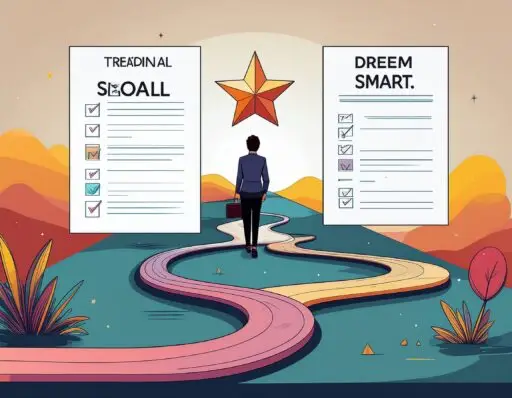
Traditional SMART goals (Specific, Measurable, Achievable, Relevant, Time-bound) were built for brains that find it relatively easy to sustain motivation through logic and structure alone. For many adults with ADHD, that isn’t enough. A goal can tick every SMART box and still never get started, because it has no emotional pull.
The Dream SMART Framework, used in ADHD coaching, keeps the practical structure of SMART goals but adds a missing ingredient: a genuine, personally meaningful “Dream” or driver behind the goal. Instead of starting with a task, Dream SMART starts with a question: why does this actually matter to you? For someone working on loneliness, the dream might be as simple as wanting to feel truly known by at least one person again. That emotional anchor is what helps an ADHD brain sustain attention and motivation once the initial burst of enthusiasm fades.
Dream SMART is for adults who have tried conventional goal-setting, ticked every box on paper, and still not followed through. It works well for emotionally loaded goals, like rebuilding a friendship, where willpower alone tends to fail. Read more about how ADHD coaches apply the Dream SMART Framework in practice, turning a goal into small, dopamine-friendly steps that fit real executive function limits, not an idealised version of “should”.
| Element | Traditional SMART | Dream SMART |
|---|---|---|
| Specific | Defines the task in detail | Defines the task and links it to a specific personal dream |
| Measurable | Tracks numbers and deadlines | Tracks progress and how it feels, not only the numbers |
| Achievable | Judged by external logic — “this is realistic” | Judged by what your ADHD brain can actually sustain this week |
| Relevant | Relevant to a plan or role | Relevant to your emotional dream, not just your to-do list |
| Time-bound | Fixed deadline | Flexible checkpoints that allow for ADHD time blindness |
| Driver (Dream) | Not included | A personally meaningful “why” that fuels motivation when structure alone fails |
Practical Coaching Strategies to Feel Less Alone

None of the strategies below require you to become a different kind of person. They’re designed to work with an ADHD brain, not against it.
Use body doubling for the admin of friendship
Body doubling, working alongside someone else even virtually, makes starting hard tasks easier for ADHD brains. Apply the same idea to friendship admin: message a friend and ask if you can both reply to your backlog of texts on a video call together.
Write connection scripts in advance
Reaching out often stalls at the blank message screen. Save a few ready-made messages for the moments your brain goes blank, such as “thinking of you, no reply needed” or “I’ve been struggling and haven’t said anything.” A script removes an executive function barrier that has nothing to do with how much you care.
Set a Dream SMART goal around one relationship
Instead of a vague aim like “be better at keeping in touch”, pick one specific friendship, name your dream for it, and build one small, flexible action around it. For example, a fortnightly 20-minute phone call with a fixed day but a flexible time.
Get support that understands ADHD specifically
General advice like “join a club” often fails ADHD brains that lose interest within weeks. ADHD coaching is built around how your brain actually works, and can help you turn insight into a workable routine. Read more about how ADHD can affect daily life and where coaching fits in.
Know when to ask for more support
If loneliness has tipped into something heavier, such as low mood or hopelessness, that’s a sign to seek more support than a self-help article can offer. Your GP is a reasonable first step, and organisations like Mind offer confidential, ADHD-aware support lines.
Frequently Asked Questions
This is common with ADHD and loneliness. Rejection sensitive dysphoria, masking and the executive function demands of friendship maintenance can all create emotional distance even in relationships where people genuinely care about you. Feeling unseen isn’t about how many people are around you; it’s about how few of them know the real, unfiltered version of you.
Yes. A UK study of over 7,000 adults found that higher ADHD symptoms were linked to almost two and a half times the odds of loneliness, even after adjusting for other mental health conditions. Separate research from King’s College London has linked childhood social isolation with ADHD symptoms and loneliness that persists into adulthood.
ADHD coaching can help by turning vague intentions like ‘be more social’ into specific, achievable routines that fit how your brain actually works, using frameworks like Dream SMART. A coach can also help you unpick patterns like masking or friendship avoidance that quietly drive loneliness over time.
Dream SMART is a coaching approach that adds a personal, emotionally meaningful ‘why’ to the traditional SMART goal structure. Rather than relying on logic and deadlines alone, it anchors goals in something that genuinely matters to you, which helps sustain ADHD motivation once the initial excitement fades.