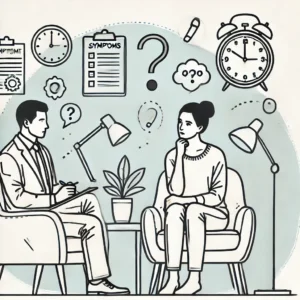

ADHD in women is the same neurodevelopmental condition seen in men, but it commonly shows up as inattention, emotional overwhelm and quiet perfectionism rather than the obvious hyperactivity long used to spot it in boys. This matters because that difference in presentation is a major reason women and girls are still diagnosed later, missed more often, and left to manage alone for years without the right support. For decades, boys were diagnosed roughly four times more often than girls in childhood. New NHS figures suggest that pattern may be starting to reverse in adulthood, with real consequences for how women get help.
What Is ADHD in Women, and Why Does It Look Different?
ADHD affects attention, impulse control and self-regulation, and the NHS ADHD Taskforce estimates that around 5% of children and 2–3% of adults in the UK have it. Yet the Taskforce is explicit that “women and girls are much less likely to have a diagnosis” than men and boys with the same underlying condition (NHS England ADHD Taskforce, 2025).
Part of the explanation is biological and social overlap. ADHD in women tends to lean towards the inattentive presentation: difficulty concentrating, losing track of tasks, and a busy, overwhelmed inner world that rarely spills out as visible disruption. Add in decades of girls being socialised to sit still, please others and cover up struggle, and it becomes much easier to see how the same underlying condition gets read completely differently depending on who has it.

How ADHD Shows Up Differently in Girls Than in Boys
Where boys with ADHD are more often flagged for hyperactivity and disruptive behaviour, girls are more likely to be daydreamy, chatty, over-apologetic or exhaustingly hard on themselves. An expert consensus statement on females with ADHD describes camouflaging — consciously copying peers, over-preparing, and rehearsing conversations — as a common coping strategy that hides symptoms from teachers, parents and even the girls themselves (Young et al., 2020).
This masking often comes at a cost. Many women describe intense rejection sensitivity, sudden emotional overwhelm, and a pattern of quietly falling apart at home after holding it together all day in public. None of this looks like the “naughty boy” stereotype most people still associate with ADHD, so it rarely triggers a referral.
Why So Many Women Are Diagnosed with ADHD Late in Life
For years, national surveys found men and women equally likely to screen positive for ADHD. That changed in the latest data: 14.9% of women screened positive for possible ADHD in 2023/4, compared with 12.4% of men — a reversal of the pattern seen in 2007 and 2014 (NHS England Digital, APMS 2023/4). Despite this, only 9.6% of adults who screened positive had actually received a professional diagnosis, showing how wide the gap between symptoms and recognition still is.
“Females with ADHD tend to experience later recognition and treatment of ADHD… partly because of diagnostic overshadowing from other mental health conditions, such as anxiety and depression, or initial misdiagnosis.” — NHS England Digital, Adult Psychiatric Morbidity Survey 2023/4, Chapter 9: ADHD
Hormones add another layer. Many women only get answers in their late thirties or forties, often after perimenopause makes long-masked symptoms impossible to ignore any longer — a pattern explored further in our guide to ADHD and menopause. By the time a diagnosis finally arrives, many women have already spent years being treated for anxiety or depression instead.
The Dream SMART Framework: A Coaching Strategy Built for How ADHD Brains Actually Work
Traditional SMART goals (Specific, Measurable, Achievable, Relevant, Time-bound) were designed for brains that stay motivated by logic and structure alone. For a woman who has spent years masking ADHD, a goal can tick every SMART box and still stall completely, because SMART says nothing about why your brain would bother, or how to recover after a setback knocks your motivation flat.
The Dream SMART Framework, used throughout ADHD coaching, keeps the useful structure of SMART but adds the emotional layer that’s usually missing. It starts with a genuine Dream or Driver — a reason that means something personally, not just a tidy target — and builds in flexibility for the emotional swings, self-doubt and burnout that so often follow late diagnosis. It’s particularly suited to women who are only now learning that the years of “trying harder” were never going to fix an unrecognised ADHD brain.
| Traditional SMART | Dream SMART |
|---|---|
| Specific — a clearly defined target | Specific — a target defined in your own words, tied to how your ADHD actually shows up |
| Measurable — numbers and deadlines | Measurable — small, visible wins that give quick dopamine feedback, not just distant metrics |
| Achievable — realistic given time and resources | Achievable — realistic given your energy and masking fatigue on any given day, not just your diary |
| Relevant — fits your broader plans | Relevant — connected to a Dream or Driver that actually motivates an ADHD brain |
| Time-bound — a fixed deadline | Time-bound — flexible check-ins that allow for rebuilding momentum after a stall, rather than treating a missed date as failure |
| No equivalent | Driver / Dream — the emotionally meaningful “why” that traditional SMART goals leave out entirely |
Practical Coaching Strategies for Women Recognising ADHD in Themselves
If parts of this sound familiar, you don’t need to wait for a formal diagnosis to start putting supportive habits in place. A validated self-screener, such as the six-item Adult ADHD Self-Report Scale available on our ADHD resources page, is a useful first step and can help you describe your experience clearly to a GP.
From there, small structural changes often help more than willpower ever will. Body doubling — working alongside someone else, in person or on a video call — can make starting tasks far easier. External systems that don’t rely on memory, like visible to-do lists or timers, tend to work better than mental notes. If clutter and half-finished projects are a source of shame, our piece on organising the chaos offers ADHD-friendly ways to make a start without the perfectionism trap.
Getting Support After a Late ADHD Diagnosis
A late diagnosis often brings relief and grief in equal measure — relief at finally having an explanation, and grief for the years spent thinking you were simply failing to cope. Both reactions are normal, and neither means you’ve missed your chance to build a life that works with your brain rather than against it.
Speaking to your GP is a sensible starting point, alongside exploring specialised ADHD coaching tailored to how ADHD interacts with hormones, caregiving, careers and the particular exhaustion of years spent masking. Coaching doesn’t require a formal diagnosis to begin, and many women find that building routines and self-understanding now makes any future NHS assessment easier, not harder.
Frequently Asked Questions
Girls with ADHD are more likely to show inattentive symptoms and masking behaviours rather than visible hyperactivity, so they’re less likely to be flagged by teachers or parents. Social pressure to appear calm and capable adds another layer that hides symptoms from the people who might otherwise refer them for assessment.
Boys are more often noticed for hyperactivity and disruptive behaviour, while girls tend to daydream, over-prepare, or become perfectionists who quietly burn out. Emotional overwhelm and rejection sensitivity are also commonly reported, particularly once masking becomes exhausting to sustain.
ADHD itself starts in childhood, even if it wasn’t recognised at the time. What often looks like new symptoms in adulthood is usually long-standing ADHD becoming harder to mask, frequently triggered by increased responsibilities, hormonal changes, or reduced structure after leaving education.
Yes. Masking can hide symptoms so effectively that even the woman herself may not recognise them as ADHD, often attributing struggles to stress, anxiety or personal failing instead. This frequently delays referral and contributes to misdiagnosis as a mood or anxiety disorder.
Coaching helps translate a new diagnosis into practical daily strategies, using frameworks like Dream SMART to build routines around genuine motivation rather than willpower. It also offers space to process the grief of a late diagnosis while building self-compassion and structure going forward.