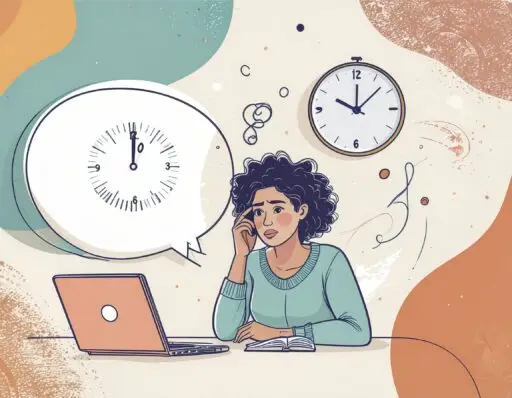

If you have ever tried to tidy a room with ADHD, you might know the feeling well. You start full of energy, get distracted by something more interesting, find a half-finished project, and within an hour the floor looks worse than before. Welcome to the world of ADHD DOOM piles — those puzzling stacks of paperwork, laundry and “I’ll deal with this later” objects that seem to multiply overnight. The good news is that there is a kind, evidence-based way to understand why ADHD DOOM piles form, and a practical coaching plan to slowly turn the chaos into calm.
What ADHD DOOM Piles Really Are
DOOM stands for “Didn’t Organise, Only Moved”. It is the very ADHD habit of relocating mess rather than processing it. A stack of post slides off the kitchen table into a basket, the basket migrates to the spare room, and a fresh pile starts on the table the next day. Nothing is wrong with you — your brain is simply trying to clear visual overwhelm using the smallest possible amount of decision-making.
Unlike clinical hoarding, ADHD DOOM piles are usually not about emotional attachment to the items inside them. They are about avoidance, decision fatigue and a brain that struggles to sustain low-stimulation tasks. The NHS describes hoarding disorder as acquiring excessive items and being unable to discard them, often causing significant distress. Most ADHD DOOM piles do not quite meet that threshold, although the two can overlap. Recognising the difference is the first step in choosing the right strategy, which is something we explore further in our piece on why chronic disorganisation happens and how to regain control.

Why Decluttering Feels Impossible With ADHD
Decluttering looks simple on Instagram, but it is in fact a marathon for the executive function system. Every object on the table triggers a chain of micro-decisions: keep, donate, bin, file, give back, fix, store. The ADHD brain, which already struggles with task initiation, working memory and emotional regulation, finds this exhausting within minutes.
NICE guidance on adult ADHD highlights that environmental and psychological strategies — including coaching, structured routines and CBT — can ease everyday functioning when medication alone is not enough. In other words, you are not lazy or unmotivated. You are running a difficult cognitive task on hardware that needs proper scaffolding.
Working memory is a particular weak spot. As you sort, you must hold the whole system in your head (“everything blue goes left, everything paper goes right”), and a single text message can wipe the plan clean. That is why “just tidy your room” is a near-impossible instruction for an ADHD brain without external structure. If this sounds painfully familiar, you may also enjoy our deeper dive into working memory challenges in everyday life.
The Hidden Link Between Hoarding and ADHD
A 2022 study from Anglia Ruskin University, published in the Journal of Psychiatric Research, found that almost one in five adults with ADHD met the threshold for clinically significant hoarding, compared with around two per cent in the general population. The strongest predictor was inattention — not hyperactivity or impulsivity. The researchers concluded that hoarding may be a hidden challenge in many adult ADHD clients and recommended that clinicians screen for it routinely.
This matters because clutter is so often dismissed as a moral failing. The evidence says otherwise. If your home regularly fills up faster than you can clear it, and the thought of letting items go feels truly distressing, it is worth speaking to your GP or an ADHD-aware therapist. Cognitive Behavioural Therapy is recommended by NICE as an effective intervention for both ADHD and hoarding disorder, and the right diagnosis opens up the right support.
For the wider group of adults whose piles are about avoidance rather than attachment, coaching is often the missing ingredient. You can read about this approach in action in our case study on breaking the loop.
A Coaching Plan Using the Dream SMART Framework
The Dream SMART Framework helps coaching clients turn a vague wish (“I want a tidy home”) into a goal an ADHD brain can actually act on. “Dream” is the first step — the emotional, motivating “why” that gives the goal meaning — while SMART makes it Specific, Measurable, Achievable, Relevant and Time-bound. Together, they keep both the heart and the executive function system engaged.
Here is how that might look for clearing one ADHD DOOM pile.
- Dream: “I want to walk into my kitchen on a Monday morning and feel calm, not stressed.”
- Specific: “I will clear the pile on the kitchen worktop, nothing else.”
- Measurable: “Two carrier bags out, one drawer reorganised, worktop wiped.”
- Achievable: “Fifteen minutes, favourite playlist on, kitchen timer set.”
- Relevant: “Mornings are my hardest time, so the kitchen matters most.”
- Time-bound: “Wednesday evening, straight after dinner.”
The trick is to choose one pile, not the whole house. ADHD brains thrive on small wins because the dopamine hit of completion fuels the next attempt. A coach can also help you build in body doubling — working alongside someone, in person or on a video call — which significantly improves task initiation. For more on this approach, see our guide to organising the chaos with ADHD-friendly methods.
Daily Habits That Stop New DOOM Piles
Once a surface is clear, the goal shifts from decluttering to maintenance. A few small habits can keep new ADHD DOOM piles from forming.
Create a “drop zone” near your front door for keys, post and bags so that incoming clutter has a single home. Build a five-minute “reset” into your bedtime routine, returning three to five items to where they actually belong. Keep a visible donation box in the hallway so that letting things go takes seconds rather than a fresh planning session. And use external prompts — phone alarms, sticky notes, a small whiteboard — to take the load off your working memory.
Be patient with relapses. ADHD is lifelong, and so are the systems that help. A messy week does not erase the progress you have made; it simply means the system needs adjusting. Coaching is particularly helpful here because a coach helps you spot patterns, troubleshoot with kindness, and side-step the shame spiral that so often follows a bad week.
If your ADHD DOOM piles are taking over your home, your relationships or your mental health, please reach out. With the right support — including specialised ADHD coaching — your space, and your headspace, can feel lighter again.