
Sound familiar? Someone asks if you can help with something and before you’ve even finished hearing the question, you’ve already said yes. You meant to think about it first. You wanted to check your workload. But the word just came out.
If you have ADHD, impulsively agreeing to new tasks is one of the most common — and most exhausting — patterns you’ll face. You end up buried under commitments you can barely remember making, let alone have the capacity to fulfil. And then the guilt kicks in.
This isn’t a character flaw. It’s neuroscience. And with the right coaching strategies, it’s something you can genuinely change.
Why ADHD Leads to Impulsive Overcommitting
To understand why you keep saying yes when you mean to say “let me think about it,” you need to understand what’s happening in your brain.
Impulsivity and inhibition control. ADHD affects the prefrontal cortex — the part of your brain responsible for pausing before acting, evaluating consequences, and comparing options. Research published in Frontiers in Human Neuroscience (Rubia, 2018) confirms that people with ADHD show reduced activity in the fronto-cingulo-striatal networks responsible for cognitive control. In plain English: the mental “brake pedal” that most people use to pause before committing doesn’t work as reliably for you.
The dopamine pull. Saying yes feels good — immediately. It sparks approval, connection, and a sense of excitement about a new possibility. Your ADHD brain, which is constantly seeking dopamine stimulation, responds strongly to that immediate reward. The consequences — the overstretched schedule, the 11pm panic — are in the future, and the ADHD brain struggles with future-oriented thinking.
Time blindness. As NICE guidelines for ADHD management note, difficulties with time perception are central to ADHD. When someone asks you to take on a task, your brain doesn’t automatically picture your current workload in real time. It doesn’t generate a realistic sense of how long things will take or how packed your week already is. So you agree — because in that moment, it feels manageable.
Working memory gaps. You might literally not bring to mind all the other things you’ve already committed to when a new request lands. Working memory deficits, well-documented in ADHD research (Nigg et al., 2005), mean existing commitments can simply fail to surface at the moment you need them most.
The Cost of Chronic Overcommitting

Impulsively agreeing to new tasks has a ripple effect that goes far beyond a busy diary. Over time, it can lead to:
- Burnout. Constantly operating beyond your capacity depletes your energy in a way that’s hard to recover from.
- Shame cycles. When you can’t deliver what you promised, the shame and self-criticism can be overwhelming — and that emotional pain often leads to avoidance, which compounds the problem.
- Damaged trust. In relationships and at work, repeated overcommitting and underdelivering can erode how others see you — even when your intentions were genuinely good.
- Task paralysis. When your to-do list becomes impossibly long, the overwhelm itself can make it hard to start anything at all.
Understanding this pattern is the first step. Recognising it as an ADHD trait — rather than a moral failing — is where real change begins. If you’d like to explore how coaching addresses overwhelm and emotional patterns, the article Breaking the Loop: Navigating ADHD Challenges with Coaching Support offers a detailed real-world look at how this unfolds.
Coaching Strategies for Managing Impulsive Overcommitting
The good news is that this pattern responds very well to structured, ADHD-informed coaching. Here are strategies that genuinely help.
1. Build a Pause Response — Before You Need It
The goal is not to make yourself more cautious in general. The goal is to install a brief, automatic pause between stimulus (someone asking you something) and response (you agreeing).
One effective approach is creating a scripted phrase you use every single time someone asks you to take something on. Something like:
“That sounds interesting — let me check what I’ve got on and come back to you.”
Practise it until it becomes automatic. The key is that this phrase commits you to nothing. It buys you time without being rude or evasive. Over time, it becomes your default first response to any new request.
This strategy connects well to the broader work of building routines and habits with ADHD. For a deeper look at how to make new habits stick, see Why Routines Feel Impossible with ADHD — And How to Build Ones That Stick.
2. Externalise Your Workload
If working memory means your existing commitments don’t automatically surface when you need them, the solution is to make them visible externally.
Maintain a simple, always-accessible task list or capacity tracker — not for productivity’s sake, but specifically so you can glance at it before agreeing to anything new. It might be a physical whiteboard, a pinned note on your phone, or a simple weekly planner. What matters is that it’s quick to access and reflects your real current load.
Before agreeing to something, make it a rule to check this list first. You’re not relying on your brain to surface the information — you’re offloading that job onto an external system.
3. Understand Your Actual Capacity
Many people with ADHD systematically underestimate how long tasks take and overestimate how much they can do. A useful coaching exercise is to keep a time-log for one or two weeks — recording how long tasks actually take, not how long you expected them to.
The insights are often eye-opening. And they give you a much more grounded basis for evaluating new requests. When someone asks you to do something that “should only take an hour,” you’ll have real evidence to consult rather than relying on optimistic guesswork.
This feeds into broader work around priorities. If you struggle to judge what’s truly urgent versus what just feels urgent, Everything Feels Urgent: Managing Priorities When You Have an ADHD Brain explores that challenge in detail.
4. Learn to Recognise the “Yes Buzz”
Part of coaching work is developing self-awareness about your internal states. The feeling that arises when someone asks you to do something new — that spark of excitement, that rush of wanting to be helpful — is real and valid. But it can also be a cue that your impulsive agreement is about to kick in.
Learning to name that feeling (“I’m feeling the yes buzz”) gives you a moment of conscious awareness before you act on it. That tiny gap is where change happens.
Metacognition — the practice of thinking about your own thinking — is one of the most powerful tools in coaching. For more on building this kind of self-awareness, the article Thinking About Thinking: Building Self-Awareness Through Coaching is well worth reading.
5. Prioritise Before Adding
Before agreeing to anything new, ask yourself: “What would I need to drop or delay to make room for this?”
This reframes the decision. Rather than adding to an already full pile, you’re making a trade. Sometimes the trade is worth it. Often, when you see it clearly, it isn’t — and you’ll find it much easier to decline or defer.
6. Work With Accountability
ADHD coaching is particularly effective because it provides external accountability and a safe space to reflect on patterns without judgement. A coach can help you notice when you’re overcommitting, explore the emotional drivers behind it (people-pleasing, fear of missing out, excitement), and develop personalised systems that work with your brain rather than against it.
If you’re wondering whether coaching might be right for you, the Getting Started page explains how the process works.
What to Do When You’ve Already Overcommitted
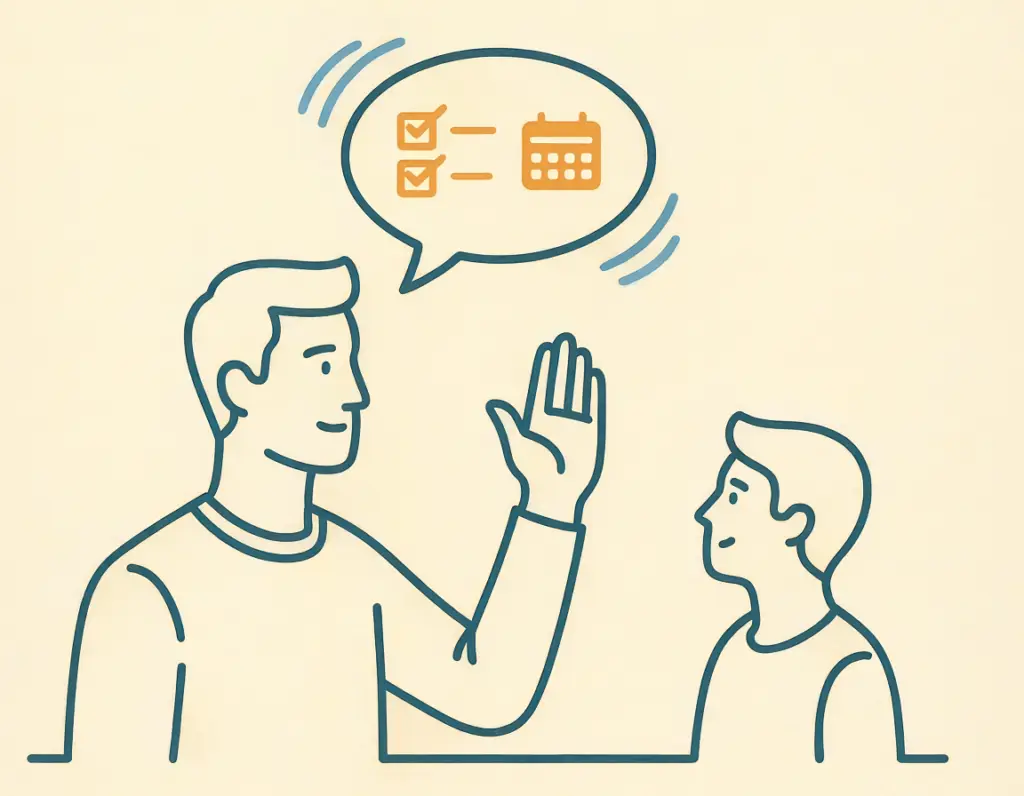
Even with the best strategies in place, you’ll sometimes find yourself with too much on your plate. When that happens:
Triage honestly. Make a physical list of everything you’ve committed to. Assign each item a rough priority. Be willing to look at that list without flinching.
Communicate early. If something isn’t going to happen on time, it’s almost always better to say so early than to go silent and deliver late or not at all. A simple message — “I’ve taken on more than I can manage this week; can we push this to [date]?” — is far less damaging to relationships than unexplained absence.
Don’t shame-spiral. Overcommitting is a recognised feature of ADHD. You’re not lazy or unreliable at your core. You’re working with a brain that makes this genuinely harder than it looks. Understanding this, not as an excuse but as accurate context, is essential for lasting change.
The Bigger Picture
Impulsively agreeing to new tasks is one expression of a broader pattern: an ADHD brain that seeks stimulation, struggles to inhibit immediate responses, and finds it hard to project consequences into a realistic future. But this is not fixed or permanent.
With coaching support, externalised systems, and practised pause responses, you can build a genuinely different relationship with commitment. One where yes means something — and where saying “let me check” becomes a source of pride, not an awkward hurdle.
The goal isn’t to become someone who never takes on new things. It’s to become someone who chooses deliberately, acts with awareness, and protects their own capacity well enough to actually follow through.
That’s not just a productivity win. It’s a wellbeing one.