How ADHD working memory and time blindness affect relationships — and practical coaching strategies to help you remember what matters most.
Forgetting important dates with ADHD is one of the most painful and misunderstood relationship challenges. You meant to send that birthday message. You planned to book a special dinner for your anniversary. But somehow, the day came and went, and now you’re watching your partner’s expression fall — not because you don’t love them, but because your brain simply didn’t hold onto the date.
This isn’t carelessness. It isn’t a lack of love. For people with ADHD, missing anniversaries, birthdays, or planned events is a direct result of how the ADHD brain processes time, memory, and future planning. Understanding why this happens — and what you can do about it — can make a real difference to your relationships.
Why ADHD Makes It Hard to Remember Important Dates
Most people assume memory works like a filing cabinet — you store a date, and when the time comes, you retrieve it. For ADHD brains, it doesn’t work that way. Several overlapping neurological factors make remembering future commitments genuinely difficult.
Working Memory Challenges
The NHS confirms that ADHD affects areas of the brain linked to attention, planning, and working memory. Working memory is your brain’s mental sticky-note system — it holds information temporarily while you act on it. Research consistently shows that adults with ADHD have impaired working memory, meaning that a date you heard on Monday may simply not make it to Friday.
This isn’t about intelligence or effort. It’s about how information travels through an ADHD brain. If a date wasn’t immediately written down or anchored in a system, there’s a good chance it won’t be recalled later.
Time Blindness
People with ADHD often experience what researchers call “time blindness” — a reduced ability to sense the passage of time accurately. A 2021 review in Frontiers in Psychiatry found that these time perception difficulties are linked to brain regions controlling attention and planning.
In practical terms, this means someone with ADHD might genuinely intend to send a birthday card — but their sense of “how close” the date is remains foggy until it suddenly isn’t. See our article on time blindness and ADHD for a deeper look at this experience.
The Dopamine Connection
The ADHD brain’s dopamine system also plays a key role. Dopamine affects motivation, reward, and how the brain prioritises tasks. Planning ahead for future dates — which offers no immediate reward — often doesn’t generate enough dopamine to trigger follow-through. The event feels abstract until it’s too late to prepare.
The Emotional Impact on Relationships

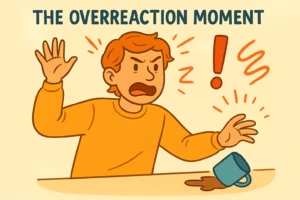
When an important date is forgotten, the person with ADHD often feels crushing shame and guilt. Their partner, meanwhile, may feel overlooked, unloved, or as though they’re simply not a priority. Both reactions are valid — and both deserve acknowledgement.
As NICE guidance NG87 notes, difficulties with organisation and memory are common ADHD symptoms that affect daily routines, relationships, and emotional wellbeing. Naming this as a symptom — not a character flaw — can be the first step to addressing it compassionately.
| A Note on Shame It’s common for people with ADHD to withdraw or over-apologise after forgetting something important, rather than calmly working through it. This links to Rejection Sensitivity Dysphoria (RSD) — the intense emotional pain that comes with perceived failure or criticism. Managing mood swings and emotional responses is an important part of ADHD coaching. You can read more in our guide on managing ADHD mood swings. |
Practical Coaching Strategies: How to Remember What Matters
The good news is that forgetting important dates with ADHD is a solvable problem. Not by trying harder to remember, but by building external systems that do the remembering for you.
1. Externalise Your Memory Completely
Your internal memory is not reliable enough for annual dates — and that’s okay. The solution is to stop relying on it entirely.
- Create a “Loved Ones” calendar: Set up a dedicated digital calendar for important dates — birthdays, anniversaries, school events. Add every date you can think of right now.
- Set layered reminders: One reminder a month before, one a week before, and one three days before. This gives you time to actually do something meaningful.
- Use your voice: When someone tells you an important date, immediately say it aloud and set a phone reminder on the spot. Don’t trust yourself to do it later.
2. Build a Date Anchor Routine
Habit stacking is a powerful ADHD tool. Attach a regular date-check to something you already do consistently.
- Every Sunday evening, spend five minutes reviewing your calendar for the coming month.
- Pair this with something pleasant — a cup of tea, your favourite playlist — to help the brain associate it with reward.
- In our article on building routines with ADHD, we explore how habit stacking helps turn irregular behaviours into reliable patterns.
3. Involve Your Partner Openly
This may feel counter-intuitive, but asking a partner to give you a friendly heads-up before important dates isn’t a failure — it’s smart collaboration.
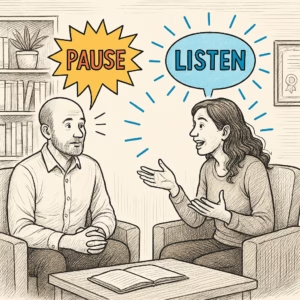
Have an honest conversation about how your ADHD affects memory. When a partner understands that forgetting is neurological rather than deliberate, the dynamic often shifts from hurt to teamwork.
- Consider a shared digital calendar (Google Calendar works well) where both partners can add and view important dates.
- Agree on a gentle nudge system — not nagging, but a simple “our anniversary is in two weeks” text.
- Acknowledge when your partner helps, and thank them genuinely.
4. Create Meaningful Rituals Around Dates
Rather than trying to remember one specific annual date perfectly, consider building regular relationship rituals that celebrate connection year-round.
- A monthly “us” date night that doesn’t rely on remembering one special day.
- Weekly check-ins where you share appreciation — this reduces the emotional weight placed on single annual events.
- A shared list of “celebration ideas” you can draw from whenever a special occasion comes up unexpectedly.
5. Make Good on Missed Dates — Without Catastrophising
When you do forget — and it will happen — how you respond matters enormously.
A genuine, specific apology goes much further than excessive self-flagellation. Say: “I’m really sorry I forgot. I know that matters to you and to us. Here’s what I’m going to do differently.” Then follow through.
Understand that impulsively over-committing after a missed date (“I’ll make it up to you, I’ll plan something huge!”) can create more problems than it solves. Our article on ADHD and overcommitting explains why the impulse to compensate can lead to further let-downs.
For Partners: What Forgotten Dates Really Mean

If you’re in a relationship with someone who has ADHD, it’s worth understanding what’s happening in their brain when they forget your birthday.
It doesn’t mean you’re not important. It doesn’t mean they don’t love you. It means their working memory didn’t hold the date — and without an external system in place, the information wasn’t retrieved in time.
That said, love requires effort. And part of supporting a partner with ADHD is helping them build the systems that allow that love to be expressed in ways that feel meaningful to you both.
| When to Seek Extra Support If forgotten dates are causing persistent conflict, feelings of neglect, or emotional withdrawal in your relationship, it may be time to speak with a professional. ADHD coaching can help you build personalised memory systems and relationship strategies. You can also explore our Therapeutic Coaching Service to find out how we work. |
A Quick Coaching Summary: What Helps Most
Here’s a brief rundown of the most effective strategies for managing forgotten dates with ADHD:
- Externalise memory entirely — digital calendars, layered reminders, voice notes.
- Set reminders weeks in advance — not the day before.
- Use habit stacking — link a weekly calendar review to an existing routine.
- Have an honest conversation — explain ADHD and memory to your loved ones.
- Use shared calendars — both partners can add and view important dates.
- Respond well to mistakes — acknowledge, apologise, and adjust your system.
- Work with a coach — build a personalised approach to organisation and relationships.
You’re Not Careless — You’re Wired Differently
Forgetting important dates with ADHD is not a moral failure. It’s a predictable outcome of a brain that processes time and memory differently. The answer isn’t shame or blame — it’s strategy.
With the right external systems, honest communication, and a bit of self-compassion, you can show up for the people who matter to you. Not perfectly, but consistently. And in relationships, consistency often matters more than perfection.
If you’d like personalised support building systems for memory, relationships, and daily life, we’d love to help. Take a look at our Getting Started page or book a free consultation today.